WALKABLE MIND / PROTOTYPE RESEARCH
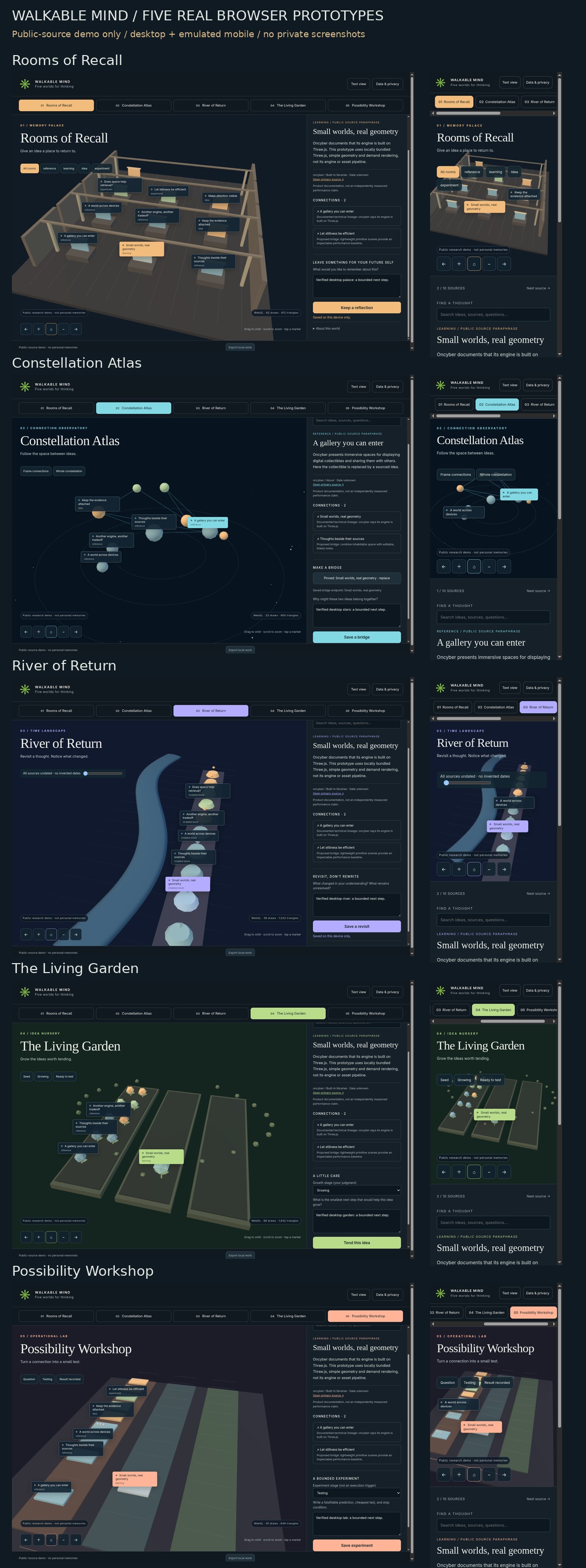
These are five navigable 3D interpretations over the same portable source pack. Their geometry, navigation aids and local actions differ. They are exploratory prototypes—not a deployed personal archive, VR system, autonomous agent or validated cognitive aid.
| World | Core operation | Distinct spatial grammar | Tradeoff |
|---|---|---|---|
| Rooms of Recall | Retrieve a source and keep a reflection | Architectural bays, exhibits, category rooms | Memorable landmarks; traversal can add friction |
| Constellation Atlas | Trace connections; pin two sources and save a proposed bridge | Orbital graph, actual connecting lines, free camera | Best for discovery; dense graphs need stronger filtering |
| River of Return | Scrub source dates and record a changed understanding | Winding river, chronological stepping stones, separate undated shore | Best for revisiting; honest date gaps make this public demo sparse |
| The Living Garden | Write a next step and move seed → growing → ready to test | Three growing beds; plant position and height change with your stage | Gentle ongoing attention; may turn into gardening busywork |
| Possibility Workshop | Write a prediction/test/stop rule and stage its progress | Three workbenches: question → testing → result recorded | Clearest useful action; least dreamlike of the five |
Recommendation: Start with Constellation Atlas for connections, with a direct handoff into Possibility Workshop. Keep Rooms of Recall as a calm re-entry mode. The river needs actual dated material; the garden needs evidence that tending produces useful outcomes rather than chores.
This is a design judgment, not the result of a user study. Compare each world against Text view on three tasks: find a source, explain an evidenced connection, and save a next action. Measure completion time, wrong selections and whether the saved action is useful.
Research caveat: direct retrieval of one Three.js optimization URL failed; one extractor response incorrectly returned Spatial content for that URL and was discarded. Only the official manual index and verified engine documentation are relied upon. Product descriptions establish features, not measured performance.
The public demo contains ten public-source / assistant-proposed research cards, not someone’s private memories. All dates without source evidence remain unknown. No fabricated people, endorsements, family photographs or autobiographical events are supplied.
A separate private, curated source pack can be imported locally. The public deployment does not contain that pack, private screenshots or raw transcripts. Imported sources remain in browser memory and disappear on reload; local notes/stages persist in localStorage on that origin/device. They are not encrypted or synced. Export is a local JSON download, not a server write. Each concept keeps its own workflow state. No live external actions execute.
No private database, archive connection or authenticated sharing service is connected. Private sources require a local file import. This demo intentionally does not change access controls.
Design budgets: no 3D models/textures/physics; device pixel ratio capped at 1.5; fewer than 150 draws in the supplied ten-card scenes; no idle render loop; geometry/material disposal on world switch. Module assets are bundled locally, so visiting does not require a third-party script CDN. The import cap is 60 records / 1 MB; this is not a claim that large knowledge graphs have been benchmarked.
Use drag/orbit, scroll/zoom, arrow keys and W/A/S/D, or the touch-sized camera controls. Use Text view and search for full source and action access without 3D. Reduced-motion preference is honored by having no autonomous animation at all. Physical iOS/Android hardware and assistive-technology conformance have not been certified.
Measured prototype test summary · Five-world screenshot comparison